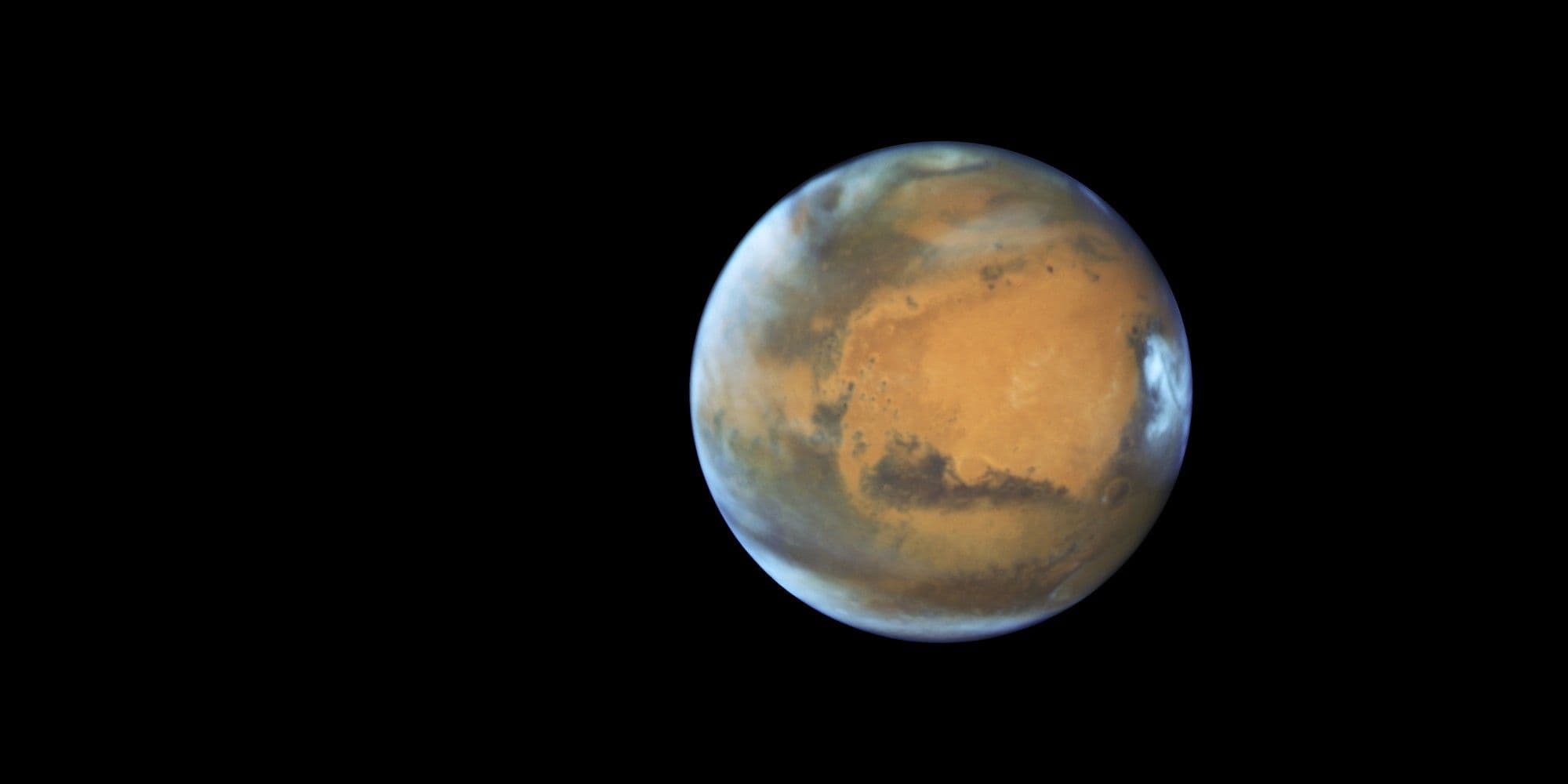
Mars, the red planet, 4th from the sun, and one of our celestial next door neighbors. For centuries, this pale red dot in the sky has harbored countless mysteries and captivated human curiosity. What is this nearby world like? Is it like Earth? Is it home to a civilization all its own? We could never quite be sure, but naturally that didn’t stop the immense power of the human imagination.
People imagined an earthlike world, with flowing rivers and oceans of liquid water. The dense Martian forest filled with alien fauna. And of course, we dreamed of the Martian. From short and stout little green men, to large menacing squid-like creatures, humanity did what we do and dreamed endlessly of our possible extra terrestrial neighbors. As years passed, and telescopes became larger and more powerful, we slowly began to replace imaginations with facts. We slowly learned more about the Martian surface. What came into view was a harsh desert landscape, certainly not lush with green forests. However the question of Martian life persisted. While we couldn’t see liquid water, we began to see what appeared to be remnants of once flowing water systems. Massive canyons, looked to be carved by flowing rivers much like on earth. Huge craters appeared more like dried lakebeds than impact sites. Unlike many other things in astronomy, the more we learned, the more it seemed like it could truly be possible for this red rock to harbor exactly what we wanted it too.
Throughout the 1900s, Mars was believed to be our best shot at discovering life beyond earth within our very own solar system. Unfortunately, as we upgraded from earthbound observatories to space faring orbiting telescopes the disappointing answer became evident. There was certainly not any current life habitating Mars. Despite this unfortunate news, this would not be the end of our search for the Martian. It would simply move the goal posts. In the early 2000s, one of NASAs orbiting spacecraft made a discovery that reopened the whole debate. Clear present evidence of frozen water ice on Mars. Followed by better and more sophisticated study, we would come to learn that a lot of what we had thought about the Martian landscape was true. There was once liquid water on the red planet, we did in fact observe long dead rivers, and ancient dry lakebeds. The picture of a habitable Mars was coming into focus, we were just looking on the wrong timeline.
The question evolved from does Mars have life, to did Mars have life in the past? This sparked an entire new interest in the red planet. Further expeditions would return to Mars from orbiting research stations, to landing stationery laboratories, to of course the famous Mars rovers. The continued flow of information began to paint a picture of an ancient world much different from the one we observe in the present. With wide flowing rivers, deep wide seas and oceans, a picture much more similar to earth than previously thought possible. Then the big shoe dropped. Mars rover Curiosity began finding organic materials on Mars, nothing as shattering as little green men of course. What it found were longchain hydrocarbons and fatty acids, fundamental building blocks for organic life as we know it. This was our first undisputed evidence of organic compounds on an alien world. This didn’t quite prove the past existence of the Martian, but it was certainly added to the list of proof that it was possible.
Using this, and the collective data of years and hundreds of scientists NASA began to build their newest rover, Perseverance. Part of a larger mission to search for, study, and even eventually return samples to our humble pale blue dot; Percy as it was lovingly nicknamed by engineers, was purpose built to search for and collect any possible evidence of life on Mars. Then suddenly, in July of 2024 Percy found something that could change our perception of Mars and the wider universe forever. Deep in Jezero crater, an ancient dried up lakebed, was a very interesting bit of rock. Rock quite unlike any other found anywhere else on the planet. This rock had signs of life. Presenting in the form of small spots of discoloration in the red rock, was what could be the biggest discovery of our species. To spare you the arduous details of wildly complicated biology, these spots in the rock were thought to be the result of ancient microbial organisms on Mars. Far from the ancient ruins of a city, or fossilized little green men but massive in its implications nonetheless. You see, we have the same type of “leopard spots” in some of our rocks here on earth, and they only form under the presence of biological microbial life. Scientists have come to the conclusion that if life did not create these spots we simply don’t know what could have. So, naturally, Percy drilled out a sample, tucked it away in its onboard storage and carried on with its travels. To be 100% certain that these spots are indeed the result of life, we would have to return the sample to earth. As sophisticated of a mobile lab Percy is, it does not contain the proper instruments to prove the theory beyond a reasonable doubt.
So why do we not have this sample on earth? Why are we not in the process of returning it? A tale as old as time, it costs too much. There’s a handful of other reasons that get bandied about, and there’s even some truth to them. The sample return mission would be an undertaking, like none other. Groundbreaking in quite literally every way, the mission would mark 8 “firstevers” from the first transfer of a sample from vehicle to vehicle, from the first ever launch off another planet. But I ask, when has that ever stopped us before? Everything humans have ever accomplished was once thought impossible, was once done for the first time. In space travel especially, the entire practice is built on firsts. No in the end my friend, I believe it comes down to the age old question of return on investment. What new technology, or profit incentive is there to proving that microbes once existed on this remote world? Likely none. However it has the ability to answer life's oldest questions in a truly remarkable way.
For us to find life on Mars, to discover that life evolved twice, on neighboring planets in the same solar system would fundamentally alter our perception of the universe. It would tell us not only that we are not alone in the universe, but that the universe could be in fact teeming with life scattered throughout its infinite void. If that's not worth a few bucks, I certainly have no idea what is.