According to the Greeks, the hero Perseus was a great hero who slew the gorgon Medusa. As a tribute to his heroic deeds, the gods honored Perseus by placing him in the stars. He is depicted holding out Medusa’s head and bearing the sword Hermes gifted him for the task above his head. On the handle of this sword was an inlaid jewel. In our modern day constellation and visible to the naked eye, is Caldwell 14.
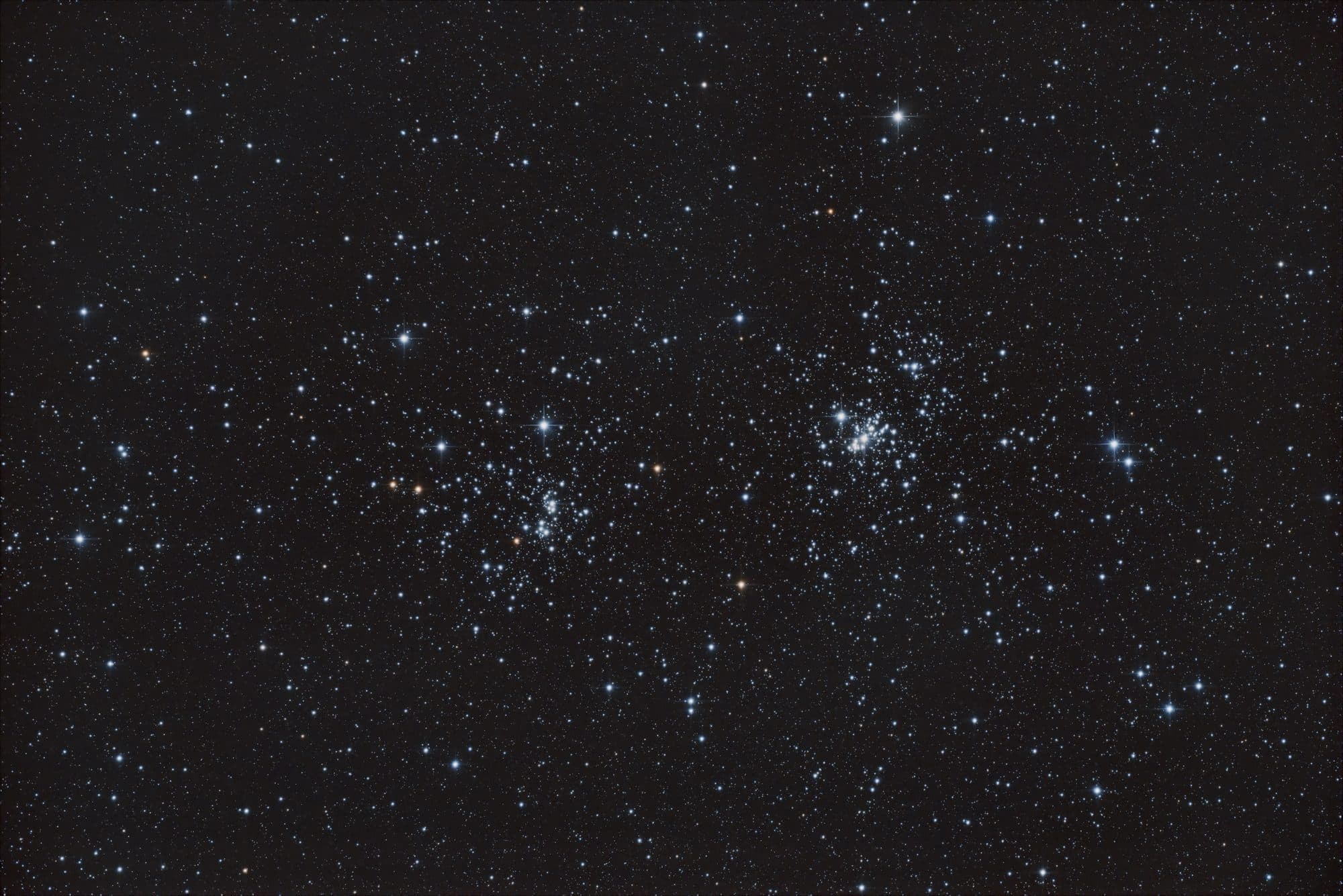
Known better to amateur astronomers as the Double Cluster, this object is actually two open clusters. Residing about 300 lightyears away from each other and ranging from 7,460 to 7,640 lightyears away from Earth, these open clusters are easily separated in the view of binoculars and telescopes.
An open cluster is a loosely grouped cluster of young stars. These stars are the remnants of a molecular cloud. A molecular cloud is a cold and dense portion of space filled with gas and dust. In the densest portions, the gas and dust begin to clump together, forming a star. These young stars, driven by radiation pressure, produce stellar winds that drive away the gas and dust surrounding them. Other disturbances within the molecular cloud, like supernova explosions and gravitational collapses, can aid the dispersal of the cloud.
Open clusters are one step in stellar evolution. Because these clusters are relatively small, their escape velocities (or how much speed an object needs to be moving to leave) tend to be very low, meaning that their stars will drift away. This process can take a few hundred million years for small clusters up to a billion or so years for large clusters.
Don’t worry too much about the fate of the Double Cluster, as both are relatively young, only being 14 million years old. It’s thought that these clusters formed from the same molecular cloud at the same time, just like twins!
Open clusters are very important for viewing the stellar evolution of stars, particularly high-mass ones. High-mass stars don’t live very long lives, so it’s key to view them soon after their formation. Open clusters are prime locations for this. The Double Cluster is home to some red supergiant stars, showcasing how quickly these high-mass stars die out. For context, our Sun is about halfway through its life at 4.5 billion years old, compared to these red supergiants 14 million years.
The Double Cluster is circumpolar to most northern latitudes, meaning it never sets. It appears to be a bright patch of light in between the constellations of Cassiopeia and Perseus. So tonight, take a look to the north and try to spot the wonderful Double Cluster!