You’ve probably heard people get excited about a meteor shower’s peak, but you may not know what to expect. A meteor shower produces far more shooting stars than usual, and despite the name, those shooting stars aren’t stars at all. To understand what they really are, it helps to know where a meteor shower comes from.
Most major meteor showers start with a comet. As that comet whips around our solar system it leaves behind a trail of debris. This debris can be made up of ice, frozen gases, organic material, or rock and is often between the size of a grain of sand and a pea. As the Earth orbits the sun and passes through this trail of debris, these little specks burn up in our atmosphere causing the beautiful shooting stars. It’s kind of like driving through a cloud of bugs as you speed down the highway! The comet debris is the bugs and our atmosphere is the windshield of your car. Luckily, it's much more beautiful than bugs on a windshield!
Halley’s Comet is the origin of the Eta Aquarids in May and the Orionid meteor shower in October; the latter being one of the best of the year thanks to its high number of shooting stars per hour, their brightness, and their long duration. The comet itself is made of frozen water, carbon dioxide, methane, ammonia, dust, and rock.
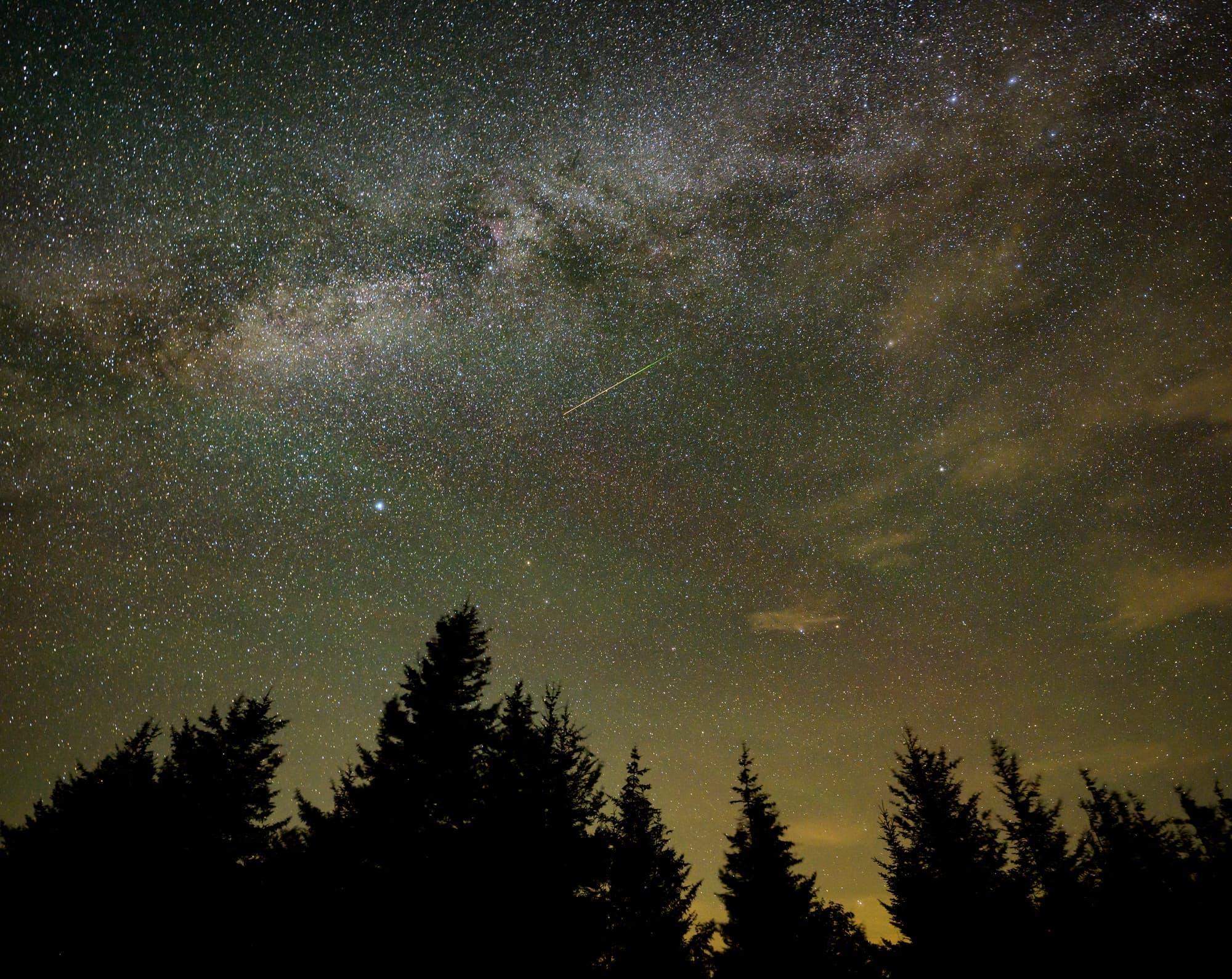
Some meteor showers, like the Perseids and Leonids, are known for the colorful trails attached to the meteors. These colors come from the minerals in the meteor and the gases in our atmosphere glowing as the meteor burns up, similar to the process used to create firework colors. They can be blue, green, yellow, or even red!
There are around 30 meteor showers per year that are commonly visible in the right conditions. Meteor showers are named after the constellation from which meteors appear to originate in the sky. So, if you’re hoping to see the Orionid meteor shower this October, your best bet for seeing shooting stars is to look toward the constellation Orion rising in the East around midnight! The darker the sky, the better the chances of seeing shooting stars. So make sure you head to an area with little light pollution and check the moon phase, since a bright moon can wash out fainter meteors.
So what can you expect from a meteor shower? A few fast, bright streaks, the chance of a colorful trail, and under the right conditions, a memory you won’t forget.