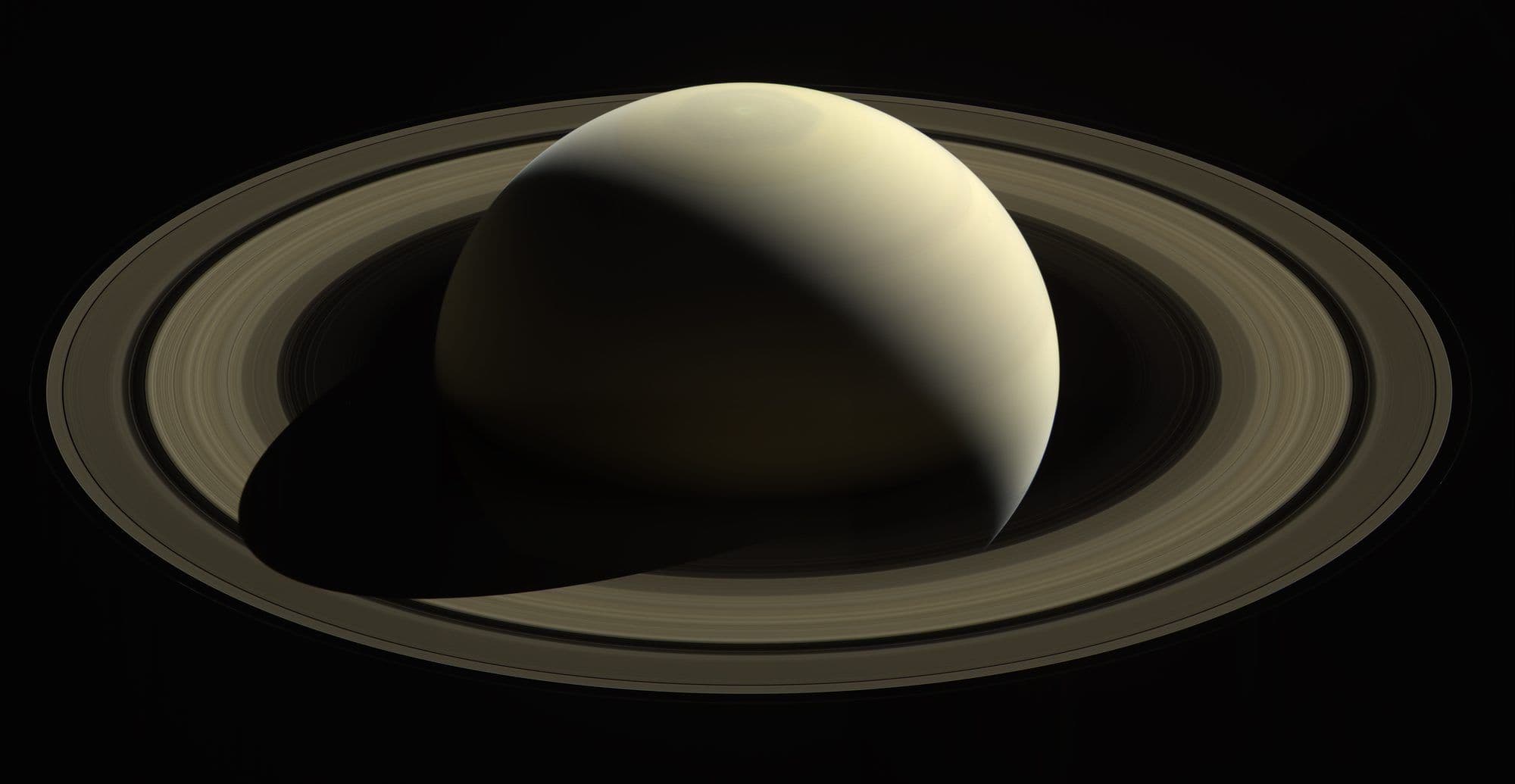
Currently resting in the eastern sky is a planet moving backwards. This planet is Saturn, and while nothing on the cosmic level has changed its orbit, if you watched its movement across the sky, it would be moving east to west, opposite of the proper motion of other planets. This is called retrograde motion, and it’s temporary.
As the Earth moves along its orbit, it occasionally catches up and passes other planets during their races around the sun. Earth takes one Earth year, or about 365.25 Earth days, to orbit our Sun. Saturn takes about 29.4 Earth years, or 10,756 Earth days, to orbit the Sun. Because of this, the Earth laps Saturn every 7 to 8 months. During this lapping period, which is 4 to 5 months long, Saturn appears to move backwards across the sky.
This year, Saturn entered retrograde on July 26th and will begin to move direct, or west to east, on December 10th. The middle of this period is when Saturn is closest to Earth, its opposition. At a distance of 746 million miles, this will occur on October 4th.
While Saturn’s retrograde motion is just an optical illusion for us here on Earth, Saturn has many moons that really do orbit backwards. Of Saturn’s 293 moons, 210 of these moons have retrograde orbits. These 210 moons are referred to as the Norse group and are captured asteroids.
As Saturn is orbiting around the Sun, its gravitational pull resulting from its mass, 95 times that of Earth, can influence asteroids and pull them into orbit around the planet. These asteroids were captured in a way that caused them to orbit in the opposite direction of the planet’s rotation. As these asteroids are then a natural satellite of the planet, they are referred to as moons.
The largest retrograde moon of Saturn is Phoebe, which is only 4% of the largest moon of Saturn, Titan. Phoebe is the second largest moon with a retrograde orbit, being dwarfed by Neptune’s moon Triton. Being a captured moon, Phoebe is theorized to have originated in the Kuiper Belt.
Saturn gives us two interesting views of retrograde motion in our solar system. So for the next few months, look up and see if you can spot Saturn’s apparent retrograde motion!