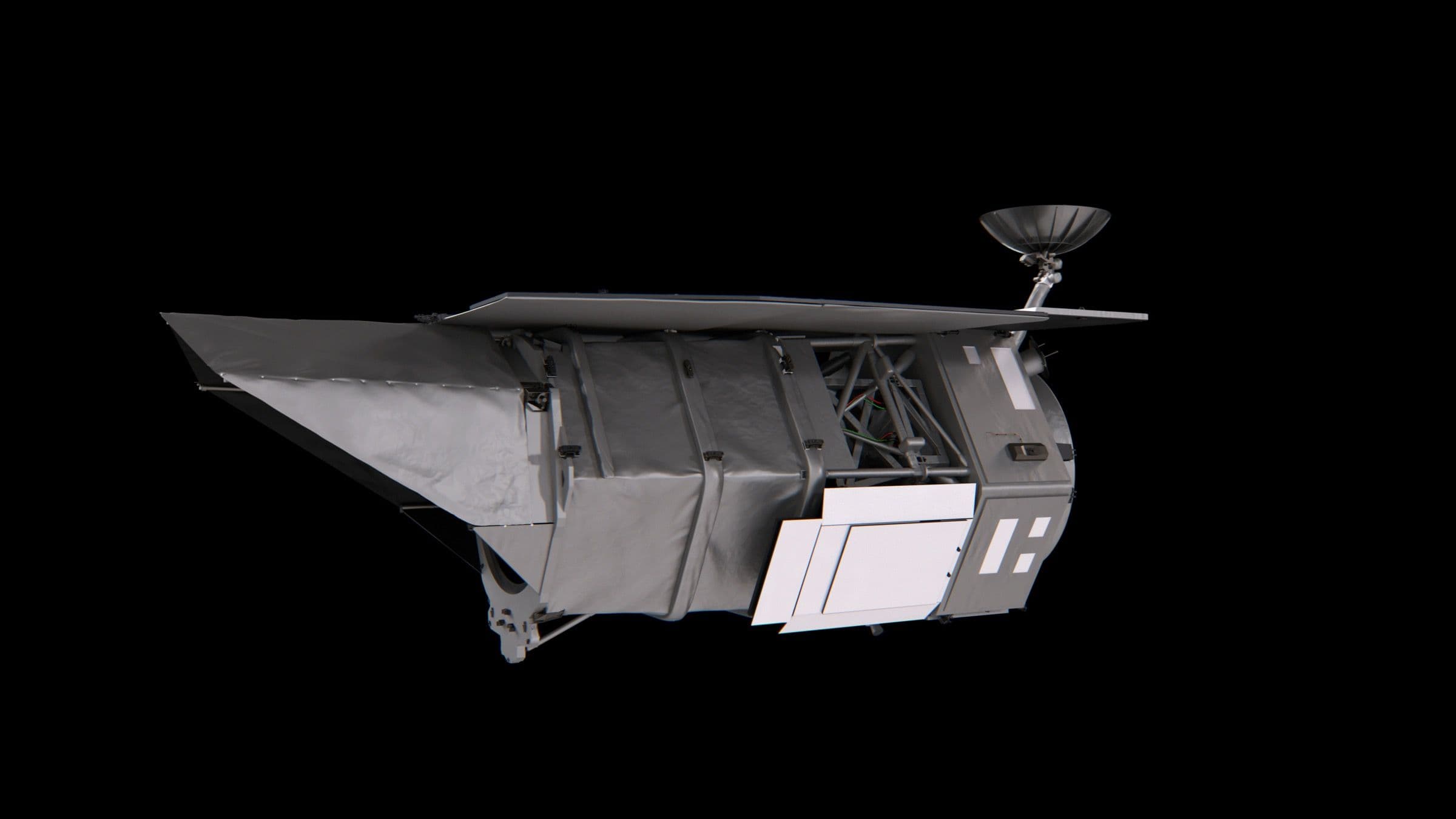
Next month on August 30th we will celebrate the launch of the Nancy Grace Roman Space Telescope, a survey powerhouse that will allow us to explore more deeply the secrets of exoplanets, dark energy, and infrared astrophysics as it captures the vast expanses of the universe in impressive detail.
Named after the “mother of the Hubble,” this telescope will boast a field of view 100 times larger than the one she helped bring to life. Using a 300 megapixel infrared camera we can virtually look back in time, capturing light that has traveled billions of years to reach us, as we study the early stages of the universe and how it came to be. (Even Ryland Grace and Rocky would be amazed, amazed, amazed!) This same camera will also help us to detect and study dark energy and dark matter. These mysterious components make up 95% of the known universe yet we only know they exist because of their effects on observable matter. Very soon we could dramatically expand our understanding of the universe and its incredible creations!
To make these observations, the Roman telescope will travel to a gravitationally stable point in space known as L2 about 930,000 miles from Earth, on the side facing away from the sun. Its barrel-like shape will block out unwanted light from the sun, Earth, and moon, allowing it to solve the riddles hiding in the truly dark spots of our sky. Its strategic position and light blocking technology will allow it to image planets outside of our solar system, worlds that, until now, have rarely been seen in great detail!
As of 2025 NASA has officially confirmed over 6,000 known exoplanets. Of these 6,000 fewer than 2% have been imaged directly and in detail. This is partially because the light from their parent star can overshadow the faint light the planet reflects, which is what allows telescopes to detect it. The Nancy Grace Roman telescope is expected to multiply the number of confirmed exoplanets to around 100,000 in just five years.
Will the Roman Telescope find another Earth? We can’t be sure, but it's laying the groundwork for the missions that might. Its coronagraph technology is a critical step toward telescopes built specifically to search for habitable worlds and signs of life beyond our own. Over the next several years, we may discover more than we ever thought possible, all thanks to the Nancy Grace Roman Telescope and the legacy of astronomers whose work brought us to this moment.