Orion: Best viewed between November and April, this celestial warrior is one of our most prominent winter constellations in the northern hemisphere. His story originates in ancient Greece, where Orion was said to be gigantic in stature when he was alive, and among the most handsome of all men. Now he lives on in the sky, where many people know him only by his famous belt of stars.
The constellation of Orion is one of my favorites because it contains a wide variety of celestial features, ranging from the red supergiant Betelgeuse to the closest known star-forming region to Earth, aptly named the Orion Nebula.
Two of the most interesting stars in Orion are Betelgeuse and Rigel. Betelgeuse makes up Orion’s right shoulder and appears reddish-orange to the naked eye. It is about 700 light-years away from Earth, but it is still one of the 10 brightest stars in our night sky. Almost directly underneath it, on the other side of the three stars that make up his prominent belt, is a star called Rigel. Rigel is a blue supergiant and makes up either Orion’s left knee or left foot, depending on who you ask. Rigel is the 7th brightest star in the sky and blazes at 120,000 times the brightness of our sun!! The proximity of these two stars makes an easy comparison of the color difference.
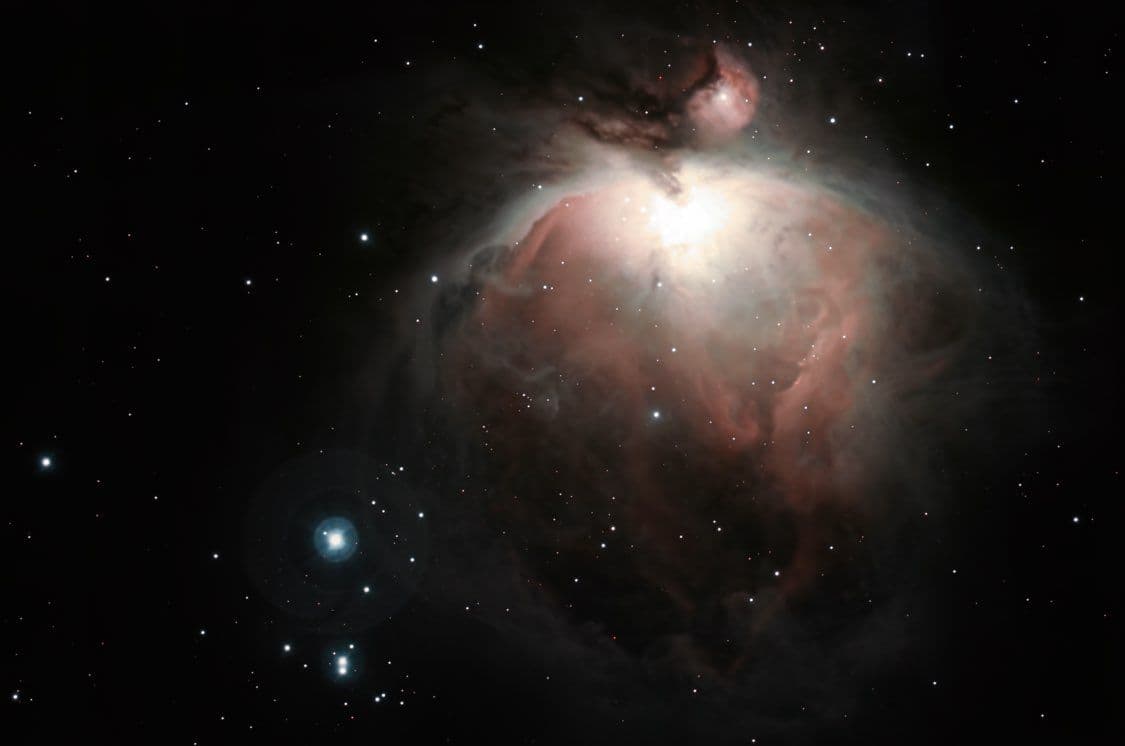
My favorite feature of this constellation is the Orion Nebula, located in a group of stars just below the belt. It is the closest nebula to us, making it one of the coolest things to view in the telescope.
Orion is situated on the celestial equator, which is directly in line with the equator we have on Earth, which means that the constellation can be seen by nearly everyone on Earth, unless you’re located very near the north or south poles. This is significant because that means Orion has been seen by almost everyone who has ever lived, giving modern-day astronomers or even just casual viewers seeing Orion’s belt from their backyard a cosmic tie to people as far back as the 8th century BC, where we find the first mention of the Orion constellation in Homer’s Iliad.
This is your sign to go outside and look up!