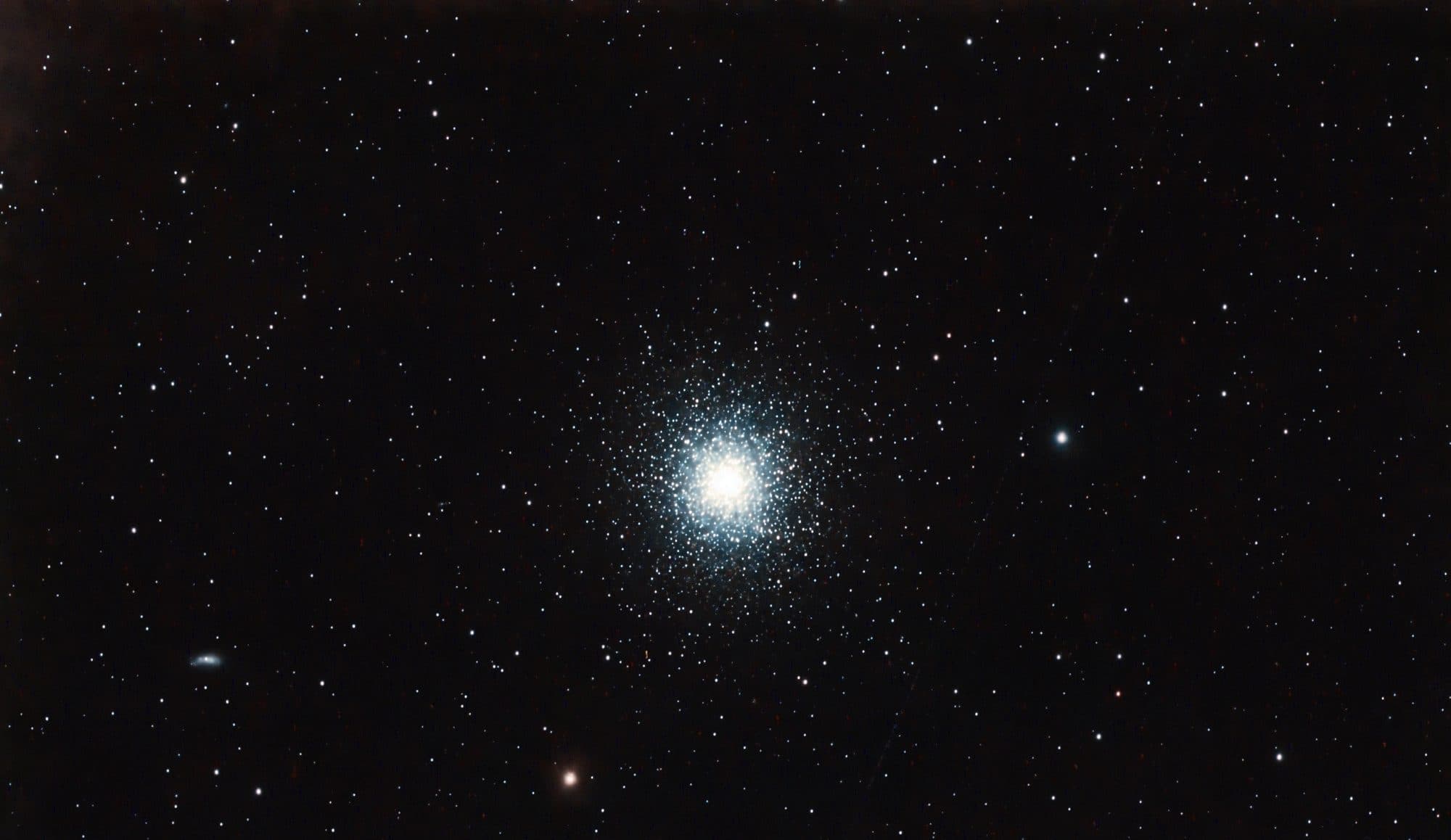
Discovered in 1714, the Hercules Cluster is a spectacular and dense collection of ancient stars. The Hercules Cluster (A.K.A. M13) is one of the brightest globular star clusters in the Northern Hemisphere. About 400,000 ancient stars form a brilliant, spherical cluster that looks like a dazzling disco ball. This globular cluster spans about 145 light years across.
There are two main types of star clusters: open and globular. Open star clusters are loosely bound, less dense and younger populations of stars, while globular star clusters are tightly gravitationally bound, vast, ancient balls of stars. Globular clusters tend to be found orbiting the galactic halo of galaxies, while open clusters usually are found in the flat disk of galaxies
The Hercules Cluster is about 25,000 light years away from Earth, which means it has taken the light from these ancient stars 25,000 years to travel into our eyes! 25,000 years ago on Earth, we were at the peak of the last Ice Age.
Stars in the Hercules Cluster are theorized to have formed from one, giant molecular cloud 13 billion years ago. These stars are low-mass and relatively cool stars, which allows them to burn through their fuel very slowly and live for billions of years. Some stars in the Hercules Cluster seem deceivingly young, these are called “blue stragglers”. Usually giant, blue stars run through their fuel quickly and die within millions of years, however in M13 stars are so densely packed together they can collide and pull mass from companion stars. These processes are called “stellar collision/merger” or “vampire stars”.
On November 16th, 1974 Carl Sagan and Frank Drake designed an international radio broadcast known as the “Arecibo message”. This 1,679 bit binary message was directed at the Hercules Cluster and is predicted to reach it in the year 26,974! The message breaks down into an image with details about Earth and humans. It contains the atomic numbers for the elements that make up human life, DNA compounds/helix, a stick-figure human, the solar system, and the Arecibo radio dish used to broadcast the message.
If you look at M13 with binoculars you will be able to see a faint, fuzzy, glowing patch of light. Look for the Hercules constellation, and identify the 4 stars that make up his body, also called the “keystone” asterism. The Hercules Cluster sits about ⅔ of the way down from Hercules’ right shoulder. It is above the star that makes up Hercules’ right hip. If you ever get the chance to look at M13 with any telescope, you are in for a treat!