Do you ever wonder what lies in space beyond what the naked eye can see?
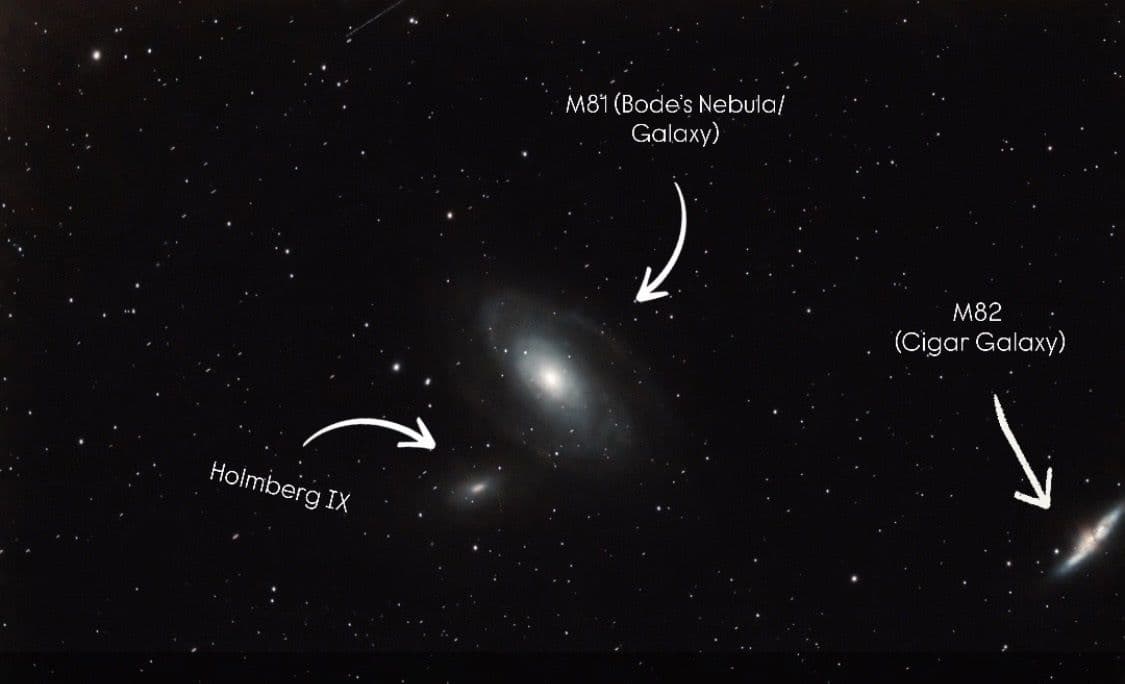
Our Celestron Origin allows us to target deep space objects, and image them through tracking, long exposures, and stacking images. 12 million light years away, deep within the Ursa Major constellation, a spectacular, gravitationally bound, triplet of galaxies has been playing cosmic bumper cars for millions of years.
Bode’s Nebula/Galaxy (M81) and the Cigar Galaxy (M82) were discovered by German astronomer Johann Bode in 1774. Johann was cataloging celestial patches in the night sky using a refracting telescope, and he described the pair as “two small nebulae 3⁄4 degrees separated”. In the late 1700s, astronomers did not have the equipment to recognize spiral structures, so all fuzzy, cloudy objects were categorized as “nebulae”. Nowadays, we recognize that Bode’s Nebula is not a nebula at all, but instead a beautiful grand-design spiral galaxy.
Bode’s Galaxy boasts well-defined, symmetrical spiral arms that are illuminated with blue wavelengths from young, hot stars. All mature, large galaxies host a black hole at their center. Bode’s center has a supermassive black hole that is 15 times the mass of Sagittarius A* (the Milky Way’s central black hole). This supermassive black hole is feeding on material fast enough to create an Active Galactic Nucleus. This AGN causes Bode’s Galaxy to have a luminous center powered by the black hole’s accretion disc and jets.
The Cigar Galaxy is often referred to as the “starburst galaxy”. Notable for its rapid star formation, stars are forming at a rate 10 times faster than the whole Milky Way Galaxy. For reference, the Milky Way is about 3 times larger than the Cigar Galaxy! The explosive supernovae from the rapid death of these stars creates galactic winds. The galactic winds blast super-heated gas and dust into space, giving the Cigar Galaxy its exploding, cloudy appearance.
Holmberg IX is a dwarf, irregular galaxy that is orbiting Bode’s Galaxy. Considered to be one of the youngest nearby galaxies, 90% of its stars are believed to be extremely young. Holmberg IX was discovered in 1959 by astronomer Sidney van den Bergh. Since Holmberg IX was discovered, NASA has been using their Hubble Space Telescope to study its star population and galactic core. Traditionally, Holmberg IX is believed to have no central galactic core and is described as having a structure in between an irregular galaxy and a dwarf spiral galaxy.
Roughly 200 to 300 million years ago Bode’s Galaxy and the Cigar Galaxy had a near-collision event. As the two galaxies passed by each other their gravity began to interact. Being the more massive object, Bode’s Galaxy pulled on the Cigar Galaxy causing the gas and dust at M82’s core to compress. This violent gravitational interaction morphed the shapes of both galaxies and created rapid star formation. Holmberg IX is often referred to as a tidal dwarf galaxy that was formed from the tidal debris of M81 and M82’s interaction.
On very clear nights, you can pretend to be Johann Bode in 1774 and grab a pair of binoculars to view Bode’s Galaxy. Start by finding the Big Dipper, and locate Phecda and Dubhe, the two stars that form the outer bottom corner of the Dipper's bowl. Draw an imaginary line starting at Phecda and running through Dubhe, then continue that same line about the same distance again past Dubhe. In binoculars Bode’s Galaxy will look like a fuzzy, blue smudge, but now you know that it is actually a galaxy involved in a million year old game of cosmic bumper cars.