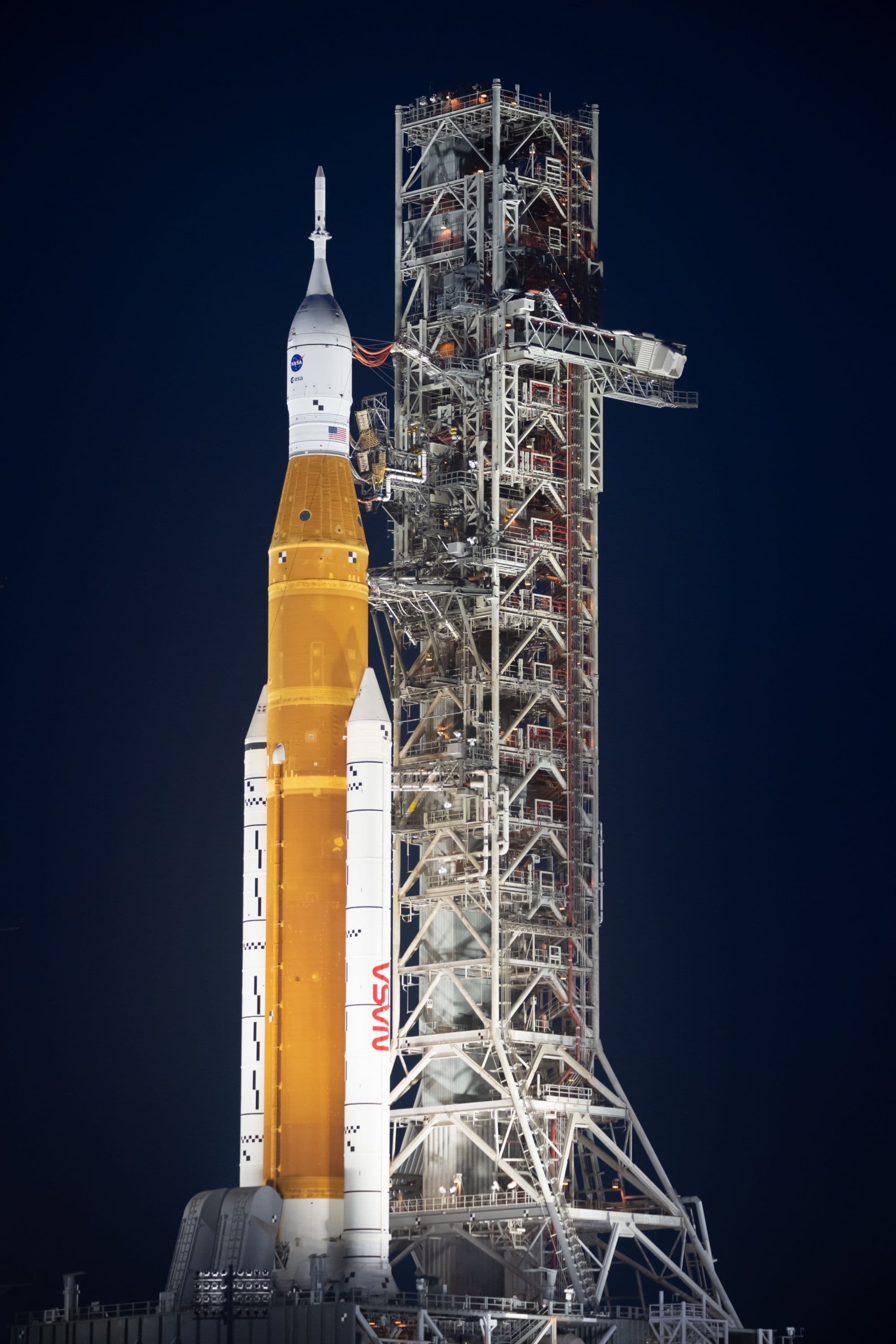
From Lewis and Clark and John Wesley Powell to Neil Armstrong and Buzz Aldrin, our country has been founded on a legacy of exploration. The desire to go beyond the frontier and past the horizon has pushed the United States from a tiny backwater along the Atlantic coast to a continent-spanning nation and a leader in global affairs. From the first days when English colonists got off their boats onto the lonely coast of America, we have been driven to find the highest point to examine what lies over the next hill, the next ridge, the next mountain range. This restless, westering spirit led us to some of the greatest discoveries and adventure narratives of the 19th century, then beyond the bounds of Earth to reach into the skies. Today, we continue this exploratory tradition with the launch of the Artemis II mission, which is intended to take astronauts further from the Earth than any human has ever gone before.
Artemis II’s launch had twice been delayed once due to a winter storm in Florida and another time due to some faulty equipment, but took off into the atmosphere with no major issues on the afternoon of April 1, 2026. Four astronauts (Reid Wiseman, Victor Glover, and Christina Koch of NASA and Jeremy Hansen of the Canadian Space Agency) were on the historic mission. I watched the launch that day at work with my heart in my throat as they blasted off from the Kennedy Space Center, conscious that I was watching history unfold before my eyes. The four astronauts followed NASA’s flight plan to the letter, launching from low earth orbit toward the moon, where they entered its orbit to use it as an orbital slingshot to launch back toward the Earth. They splashed down in the Pacific Ocean off San Diego at 5:07 PM PDT to a hero’s welcome.
Artemis II was not, however, a grand exploration on the scale of Lewis, Clark, or Powell. Instead, it’s a preliminary or a test of the systems intended for greater exploration in the future. The Artemis missions have featured international cooperation and many systems created by private space travel companies, and this mission’s purpose was to ensure that all those systems worked well together for the later Artemis missions. As currently scheduled, Artemis III will conduct lunar lander tests sometime in 2027 and Artemis IV will land humans on the moon again, for the first time in my life. After that, NASA plans to launch a moon mission roughly every year, so that Artemis V will begin the construction of a lunar habitation for astronauts to live on the moon. Aside from the sheer excitement of people living on the moon within my lifetime, this will provide NASA with the opportunity to use that moonbase as a staging ground for further exploration into our solar system. Later Artemis missions have not yet been approved, but they could possibly lead to landing on Mars for the first time.